Recently, we surveyed secondary schools up and down the country asking about Transition.
It seems like every school and area has a different way of working.
Most focus first on getting to know their pupils with activity days in school or a mock timetable.
Some give immediate tests. It seems there is not a clear way for everyone to follow.
But this is really important.
But what about academic transition?
Stalled Progress at Key Stage 3
A recent Ofsted report stated..
“the transition to secondary is too often poorly managed and teaching fails to build on the gains pupils have made in primary school. Inspectors have found that pupils often leave primary school with good literacy and numeracy skills, confident and eager to learn, but their progress then stalls when they start secondary school.”
https://www.gov.uk/government/news/too-many-students-let-down-in-early-stages-of-secondary-school
The fact is that the importance of a good start to secondary school education cannot be overstated. Pupils need to enjoy school and get involved with the many subjects to choose them at Key Stage 4.
The report continues..
“School leaders need to have a clear understanding of their pupils’ achievements in primary school and build on them effectively from the day they start secondary school life. Key stage 4 results will not improve until key stage 3 is given a greater priority by school leaders.”
https://www.gov.uk/government/news/too-many-students-let-down-in-early-stages-of-secondary-school
So how can we combat this?
How can you sustain progress in Year 7?
Create a Baseline / Immediate Testing?
For many pupils, the first weeks of secondary school are exciting, but they’re also demanding.
They’re navigating a new environment, new expectations, new teachers, new friendship groups, and a completely different daily routine.
It’s often during this period that schools choose to assess them again.
While baseline assessments can provide useful information, they are conducted at a time when pupils may be anxious, distracted, or still finding their feet. They also consume valuable teaching time and can take weeks to administer, analyse, and convert into meaningful action.
Immediate testing makes the start of term even more daunting for pupils. It may even give you false results as performance can be upset by anxiety and more.
So rather than asking pupils to prove what they know again, perhaps the better question is:
Have we fully understood what they already told us at KS2?
Why not use the KS2 SATs?
KS2 SATs provide far more than a scaled score.
They are independently marked, nationally standardised assessments that sit at the heart of a pupil’s transition from primary to secondary education and ultimately contribute to future Progress 8 measures.
Yet most schools only see the headline outcome.
This is despite the fact that progress at Secondary School is judged on these grades!
So how is the KS2 SATs data used in Secondary Schools?
A recent report into how data was used in schools showed that..
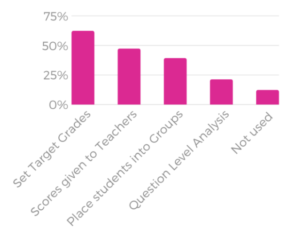
62% of teachers said that KS2 results are used to set target achievement grades and yet only
47% said that the scores are given to teaching staff.
41% said that their school used the SATs to put students into groups
Only 21% said that the school used detailed Question Level Analysis of KS2 results to help identify specific weaknesses.

Why not use the Question Level Analysis?
Behind every SATs result sits a detailed picture of what pupils know, understand, and where they have struggled. Every question answered correctly or incorrectly tells a story about curriculum knowledge, conceptual understanding, strengths, misconceptions, and barriers to progress.
For better or worse, your Year 7 SATs results are the baseline for your Progress 8 scores in five years’ time.
The challenge isn’t a lack of evidence.
The challenge is turning that evidence into understanding.
3 Ways to solve the problem of Year 7 Maths
As Peter Maddock, Head of Maths explained in his article in TES: Three ways to solve the problem of Year 7 maths
Wait before you baseline pupils – if you are in a school that routinely sets pupils on entry, you may as well actually use their KS2 Sats scores. Doing a baseline in the first few days and then using this to set could well be less accurate, despite many people thinking the opposite.
If performance is being upset by anxiety around a new school, then your baseline could well be giving you false results. Even if you do normally set the pupils late in the year, or teach mixed ability for the whole of year 7, try and wait until pupils have settled into the routine of your school before you attempt to do any sort of baseline test that is designed to discriminate based on performance.
In my school, we teach mixed ability in Year 7, but we do use a baseline test to see if there are pupils who would benefit from intervention in numerosity, or, conversely, if there are pupils whose Sats might suggest they do whereas, in fact, they don’t.
For next year I will be changing this practice so that Early intervention is planned around KS2 Sats Question Level Analysis, and then the baseline test won’t be conducted until the end of the first unit.
Big Journeys begin with Small Steps
This is where QLA Transition changes the conversation.
Instead of focusing solely on attainment, Question Level Analysis explores the knowledge and understanding beneath the score.
It reveals:
- Which concepts have been securely mastered
- Which areas may require reinforcement
- Common misconceptions across a cohort
- Patterns among different pupil groups
- Strengths and barriers within individual learners
- Opportunities for targeted intervention before issues emerge
This allows schools to start Year 7 with genuine insight rather than assumptions.
Not just knowing how well pupils performed, but understanding why.
Support the Ofsted Conversation
Ofsted conversations increasingly focus on how well leaders understand their pupils, how the curriculum builds knowledge over time, and how teaching responds to need.
Strong schools can clearly explain:
- Where pupils are starting from
- What knowledge they bring with them
- How curriculum planning reflects those starting points
- How support is targeted effectively
- How barriers to learning are identified and addressed
QLA Transition helps provide evidence for those conversations.
Rather than creating another layer of assessment, schools can demonstrate how they are using existing evidence intelligently to inform curriculum planning, intervention strategies, catch-up provision, and learner support.
The emphasis shifts from collecting more information to making better decisions.

From Data Collection to Data Utilisation
Too often, schools view transition as a data transfer exercise.
A file is sent.
A score is recorded.
A baseline test is administered.
And the cycle begins again.
But effective transition should be about continuity of understanding.
Primary schools already know a great deal about their pupils. Secondary schools need access to that insight in a format that helps them act.
By transforming raw KS2 SATs data into meaningful intelligence, QLA Transition helps bridge that gap.
Not through more testing.
Not through more workload.
But through better use of existing evidence.
A Different Way to Think About Transition
Perhaps the most powerful question for school leaders is this:
If national assessments have already provided a robust picture of pupil attainment and understanding, why spend the first half-term rediscovering it?
The schools making the strongest start in Year 7 are often those that arrive at Day One already equipped with insight.
They understand strengths.
They understand gaps.
They understand barriers.
Most importantly, they understand their pupils.
Because effective transition isn’t about collecting more data.
It’s about making better use of the data you already have.
QLA Transition from DAISI Education
Every Year 7 pupil arrives with a story. The question is: how much of that story can you see?
Behind every scaled score sits invaluable intelligence about what pupils know, where misconceptions exist, and which curriculum areas will need the greatest focus to secure future success.
DAISI Education’s QLA Transition Analysis transforms KS2 SATs results into clear, actionable evidence, giving secondary leaders the confidence to understand starting points, strengthen curriculum planning, target intervention and evidence decision-making with precision.
Whether you’re preparing for inspection, refining your curriculum, supporting vulnerable learners or laying the foundations for strong Progress 8 outcomes, QLA Transition provides the insight needed to move from assumption to understanding.
Don’t just inherit data. Understand it. Go Beyond the Scaled Score.
DAISI Education

Thank you for reading this article.
Find out how we can help your school: Primary | Secondary
Find other Blog articles by clicking below…
- Make the move from Numbers to Narrative
- The Best Schools don’t just collect Data. They use it
- “The 1% Principal” (or how to change your School)
- Take a Group Deep Dive to improve outcomes
- QLA – The Tool you cannot afford to miss
- Never Stop Learning
- Release the Potential of Analysis
- What do you find in a DAISI QLA?
- How can you sustain progress from Primary School?
- What will Ofsted Inspections look like in your school?
Really interesting discussion.
Thank you, please share
This is an area that has been ignored for many years – Thank you DAISI for creating something that we can use..
Thank you. We truly believe that it will help sustain progress – please share with others
Some good points made here. At our school, we do immediate testing of our new year 7s so we can set target grades but can understand how the SATs could also provide it? Would really like to see your analysis.
Hi D, Thank you for your comment. For more information (including sample pages) – use this link: https://daisi.education/transition-qla-explained/
I do not trust the KS2 SATs as they are so teacher trained. Would rather do a test when they reach secondary..
Hi Lynn. Thank you for your comment.
We have have sadly heard this from many secondary staff regarding the KS2 SATs which has always puzzled us. For some reason, they do not have the same reservations with GCSEs saying the pupils earned the results themselves despite the many “teacher trained” hours of revision.
Remember too – your progress 8 measure is based on the KS2 SATs results (not your own baseline).
The fact is that the KS2 SATs are a standardised assessments and marked independently and so do give a clear and unbiased account of your new year 7s academic ability. So why not use them to at the start of Year 7?
I’ve worked in schools for a long time now and can honestly say that the insight we got from the DAISI transition analysis made a real difference in our Maths department. I cannot recommend them enough.
Thank you T for the recommendation.
Would love to know more about how you used the Transition QLA in detail.
An interesting read – makes you wonder why more people don’t use that. Where was your graph from?
Thank you James, the graph was created from answers to a TeacherTapp question. It amazes us that more schools don’t use the KS2 SATs in a more directed way.
Useful summary
Thank you for your comment
This looks really interesting…
Thank you for your comment E!!